Inspired by current trends in Twitter discourse as usual, I felt compelled to produce a good old fashioned think piece about think pieces.
Fan generated discourse is, in all likelihood, a qualitative good. Not just because it is human interaction. What fan generated/led discourse has done, particularly in the internet era, has made it more acceptable for people entering some sort of artistic endeavour to interact with fans. This interaction then is able to influence the way things are presented or developed, often to the benefit of an even larger audience. It also normalizes fandom and makes it easier for people who start as fans to progress into industry rather than being seen as unnecessarily attached.
I start with that paragraph for a reason; fan generated/led discourse also has the potential for negatives. By overly encumbering the vision of the creatives with the will of the most hardcore fans, it makes for increasingly insular art. Avengers: Infinity War can be used as an example of this. On one hand, it is incredible that a major movie studio had the willingness to build towards a massive event film over a decade via 20+ other films and several series of programmatic television. It has lived up, in many ways, to the desires of the most core audience by staying stunningly authentic to a very, very dense mythology. The success of Avengers also can't be ignored: Infinity War crossed 1.7 billion dollars in global ticket sales this week, and at minimum will be the 4th highest grossing film ever. 3 other films in the Marvel Cinematic Universe exist along with it. The negative in this? Movie attendance in the US fell to record lows in 2018.
While there is a die-hard market for Marvel films that far exceeds the number of people who actually read the comics, the fact of the matter is that the market is still only a small overall fraction of the American public. We can surround ourselves with people much like us who think like we do and by and large agree with us, but ultimately, that's not representative of the movie going, TV watching, or theme park visiting public at large. The tendency then is to focus on when the public agrees with the things we like; They reacted strongly to The Wizarding World of Harry Potter, which proves that it is good (if not a model for the rest of the industry). They didn't react nearly as strongly to World of Avatar, which makes it just OK. Disneysea succeeded immediately while Disney Studios Paris still struggles: again, evidence that confirms prior beliefs about building expensive themed rides vs. not doing it.
As a result of our seeking likeminded people to link up with in virtual communities, we are used to finding ourselves surrounded with positive feedback to our ideas, and critical feedback being primarily the result of "trolling", or at least easilydismissable as such. We're hard wired to want to be right about our gut instinct, and our desires for reinforcement when matched with the advanced friend-making algorithms of Twitter and Facebook ensures that we should be able to find exactly that reinforcement no matter what. As a result of this, art as a whole online - music, video games, comic books, pro wrestling, and yes, theme parks - gets cut apart and stitched back together by amateur philosophers on an hourly basis. But no matter how many words are written, no matter how many brain cells go into it, how often do people challenge their own beliefs and orthodoxies when writing some new great think piece? It's easy to point at the success of Shanghai Disneyland and state that it is the result of unique attractions; it is another to look at Universal Studios Osaka overtaking Disneysea in attendance and try to rationalize their B&M Flying Coaster with a supposed demand from the general public for fully realized themed worlds.
There are fundamental, basic, inexorable realities about theme parks:
-What we discuss as being "theme parks" are amusement parks, different only in the expense of developing artificial rocks and training materials. There are no theme parks which exist in this world for any purpose other than recreational entertainment. It is almost certain that none will ever be built, as there is no demand for a facility in which people pay money and leave having had an existential crisis. Yes, I'm including EPCOT; aside from being an expansion of the same strategy and business model already used at Tomorrowland by Disney, you can go back even further into the history books and find correlatives. Luna Park in Coney Island NY once had infant incubators with real live infants in them being saved from death. How many babies did EPCOT save?
-The only theme parks which are not intended to maximize profit for owners and investors are non-profit entities like Arnold's Park in Iowa. Theme park blogs don't go to Arnold's Park because it doesn't have a $100 million dollar dark ride themed to a movie they enjoy (or at least some iteration of the movie before the characters were recast). Everything else since time eternal has looked to make lots of money. They have spent money to make money, but they always were in the business of making money first and foremost.
-Because of the cost of construction and maintenance, theme parks as we know them must appeal to as wide an audience as possible. That means families with small children and senior citizens. Because they must appeal to audiences that are A) incredibly simple cognitively B) disproportionately socially conservative, attractions cannot offer any real insight into the human condition or the future of the world. No one will pay $125 to ride the Nihilist Adventure a second time.
-Theme parks primarily make money by selling souvenirs and food/beverage to patrons. Walt gave away the gate in 1955 specifically to do this. Pay-One-Price being introduced by Six Flags was a way to establish "value" for the same purpose. This is what amusement parks (which theme parks, again, are) do.
-Theme parks are escapism, arguably no different than recreational drugs. Filled with surrealistic/hyper real imagery, parks actively seek to activate our brain's pleasure centers while also reassuring us of our importance by catering to us as individualistically as possible. The desire to create increasingly ornate themed areas and integrate elements of cosplay/LARP may be related to this; chasing the dragon of a greater and greater escapist high while refusing to admit one has a "problem" in the first place.
(This is also why some of the Theme Park Fan Analysis of Westworld is so concerning; the show almost goes out of its way to express to us that the existence of Westworld isn't desirable. Itshouldn't be cheered. And yet the wish that it could exist for the purpose of living out sociopathic fantasies like 3D Red Dead Redemption is strong in the community. One might even draw a comparison to technocrats at large on this and whether there is crossover)
This doesn't mean we can't critique parks. This doesn't mean we can't debate what rides are better. This doesn't mean we can't argue over whether or not shows, movies, haunts, restaurants, soft serve ice cream, or literally anything has qualities have positive or negative qualities in contrast to other similar things. There's lots of great debates we could and perhaps should have as fans. What doesn't do us any good is to start pretending that theme parks are something other than what they are. People go to theme parks to escape the real world by (primarily) going on amusement rides, and the ones that most people claim as being "the best" are ones which best generate that sense of escapism where people can safely be separated from their professional or personal fears.
That's what theme parks are. That is all they have ever been. That is all they will ever be. They are not and will never be at the same depth of art as Kurosawa's film or Puccini's operas. The greatest visual artists in history rarely have the capacity to properly express ideas about masculinity, human conflict, or romantic relationships when given 2 hours and miles of celluloid. Someone with 5 minutes and Chuck E Cheese robots has no chance. It is sophistry to suggest that they've somehow been denied the opportunity.
If ratcheting up the illusion is necessary not because it is produces an actively better product for the market, but because as individuals fans-turned-content producers subconsciously seek to escape their problems, then perhaps those problems should be confronted rather than make parks and attractions into behavioral intervention strategies. Animal Kingdom's World of Avatar, Universal's Fast and the Furious Supercharged and Jimmy Fallon attractions, and the slate of upcoming rides and lands for both parks are pushing forward with expensive pre-shows and queue lines. What about the anchor product though - what about the rides? Is spending hundreds of millions of dollars on an illusion that can be shattered by turning one's head to the side inside a theater really an advancement of the art form?
Even Walt himself didn't necessarily seem to share this view. There was no need or desire with, for example, Haunted Mansion, it's a small world, or Matterhorn to have them be surrounded by "immersive worlds." There is no detailed and exhaustive back story with those attractions. There isn't one for Pirates of The Caribbean either, for that matter, because Walt (and his 9 Old Men) knew that the medium of amusement rides was not conducive to storytelling, something quoted repeatedly from them during their lives. In speaking on his behalf, the fans and the designers they've sometimes become have molded reality and the vision of the great imagineers of the past into their own to become exactly the opposite of what was believed. And with that lack of storytelling depth in the art, the consequence of requiring stories people are already familiar with is increasingly leaned on; "intellectual properties". In this way, neither Harry Potter nor Matterhorn reflect "right" or "wrong", simply "different," and both even now can be wildly effective assuming the ride which all is built around is actively memorable.
We shouldn't talk about "resigning ourselves to getting the theme parks we deserve," but rather, look inside ourselves first before we take that tact and ask what it is we want and why. More often than not, the demands of the most critical voices in the community are at odds with not only themselves from a practical perspective, but the desires of the general public. Theme parks can offer us a sense of wonderment, but just because theme parks evoke an emotional response does not connote an endorsement of each of our individual reactions, nor a validation that it is correct and others wrong. There are many ways in which one may enjoy things, but finding something offensive or simply void of enjoyment are definitively not methods.
In 2017, Universal Orlando Resort will open Volcano Bay, a water park so advanced that they've taken to call it a full bore "theme park" with a price equivalent to its dry park brethren. It will incorporate numerous technologies previously seen outside Orlando, but does so in an integrated fashion that will be unlike any other water park in history. Teaser videos show interactivity utilizing the queue management bracelets, and it has already been tagged as "queueless"; something no other traditional water park has ever attempted. It targets the water park market with a similar sort of coalescing of advancements and refinements to bring about major change in that industry. Volcano Bay may actually be "disruptive" and change the entire future course of the Water Park industry and aquatics design.
This is a lot of hyperbole to take in, and it can end up sounding a lot like press release speak. To better understand where Volcano Bay is taking the water park industry, it is really necessary to understand how it even came to be. Unlike amusement parks, there aren't really comparable watershed facilities for most of the aquatics industry's existence that it bursts forth from in the distant past. There's no St. Bartholomew's Fair, no Vauxhall Gardens, no Coney Island, no 1893 Columbian Exposition. None of those things happen. What happened was a combination of fairly organic factors crossed with government spending and bad feelings with prior investors. In truth, the full history of what we know today as "water parks" is the very sordid history of American aquatic recreation. We must go back. Way back. Back to the very beginning....
IN THE YEAR 4000 BAL (BEFORE AQUA LOOP)
Almost since mankind found his way to regions with seismic activity or swimmable surf, water recreation followed. Records of recreational and therapeutic hot spring use have been found by archaeologists dating back upwards of 20,000 years ago. The Romans loved their baths and made them into some of the earliest recreational developments that we could compare to water parks. The fall of the Roman Empire led to the Middle Ages and a general loss of knowledge in things like plumbing, sanitation, and hygiene, and that meant the baths slowly crumbled away. Western Europe just straight up didn't know how to swim for a period of roughly 1300 years even if it seemed like it should be a necessary job skill. Sailors from merchant to military vessels couldn't tread water, and thought all it would do is prolong death. With attitudes like that, it isn't surprising that they didn't bother to have fun in wet stuff either. Yes, there were some hot springs elsewhere that were still being visited, especially in Eastern Europe and Scandinavia/Finland. Outside of the US and Europe, Japan certainly never shied away from aquatic fun with the parallel development of the "onsen" public bath. Fun fact: they were fully integrated by sex until the Meiji Period when the country was opened up to white folks.
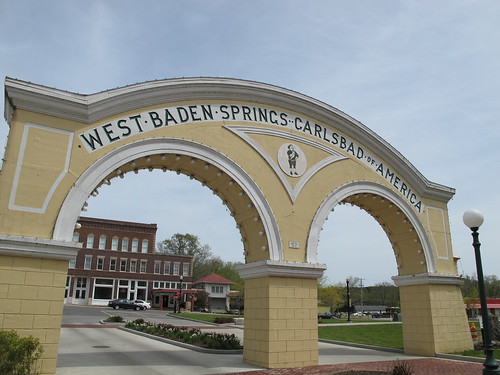
As Europeans conquered their way through the Americas and Africa, the spa idea (revisited beginning in the Renaissance and expanded on in the 18th century) came with them. Here in the United States, resorts built up around hot and mineral springs in places like West Virginia and New York. Iconography from Europe often came with this: The name "Carlsbad" was often used in tandem as an anglicized variation of Karlovy Vary, a famed spa town in the Czech Republic. Many of these continued their development right into the 20th Century, and you can see it in places like Saratoga Spa State Park, French Lick Resort in Indiana, and Hot Springs National Park in Arkansas. Pools were often constructed through which water would be channeled, promoting health and well being for all who had the funds to enjoy them.
Paralleling the spas was the movement towards use of lake and ocean beaches as places of recreation and resorts. It seems somewhat strange that the vast coastlines of Europe were not always thought of as places for rest and relaxation, but indeed, this was a novelty that came about in 18th Century Britain. Ocean water, it turned out, was filled with all sorts of minerals, just like spa water, and was quickly cited as a panacea to a variety of ills in the early-mid 1700s. Brighton Beach became the first truly recognized beach resort in modern western history thanks to a kingly visit in 1783. "Modern" and "Western" do have to be specified here: The Romans had no aversion to surf, nor the Byzantines that followed. And Amerindians? One popularly held theory on Tulum's location is that it not only served as a good port for Mayan traders, but was a resort for royalty.
THE FIRST PILLAR: SIMON BARUCH
Class separation became the first real conflict related to aquatic recreation. With beaches being plentiful, but Victorian age industrialization sparking waves of urban migration, space along the water front was still limited both by ease of access and pollution. The British tackled this via creating rail links to potential resort towns. Even today, places like Blackpool and Skegness are seen as being working class retreats. America, with its vast size, had real geographic hurdles to clear for beach going when it came to wide swaths of the population. Enter Dr. Simon Baruch. Born in modern day Poland, Baruch came to America and acted as a surgeon for the Confederate Army before heading north post-war and practicing on the poor and working class of Midtown Manhattan. It is there that he began to investigate the healing power of water. Baruch's popularity with the unwashed masses seeking to be washed spread upward, and led to the push for public baths not only in New York City, but nationally in urban centers.
(credit: New York City Parks and Recreation, link here)
So popular in New York City were the new public baths that "floating pools" were developed for individuals to take dips in the cold waters of the Hudson on buoyant platforms. This construction may have done much to change the bathing habits of people who often still did not have the benefit of running water in their homes and apartments, but it was not necessarily loved by the upper crust. An attempt to build a pool in Central Park in 1910 ran into stiff opposition, as those living nearby preferred the lower castes stay out. All the while, rich New Yorkers began to demand expansive pools at private facilities such as the New York Athletic Club. Expansion of rail to the New York beaches (Coney, Rockaway, and others) ultimately solved this issue, more or less, within the parameters of the free market model. The most extravagant bathing facilities ever were now open to all. This competition led to more and more grandiose designs right up until the stock market crash of 1929.
Amusement parks weren't blind to this development either. If they hadn't started along a bathing beach (and a great many did), swimming pools were added beginning in the 1920s. Name a park and you'll find history of a swimming pool or beach. Kennywood, Palisades, Glen Echo, and others all featured large pools. None of these pools was larger or more impressive than the one still existing today at Coney Island Cincinnati. Early metal slides and water swings offered something extra beyond just swimming and diving for activity. There can be little doubt as to how deeply connected the amusement industry was to aquatics.
THE SECOND PILLAR: FDR'S NEW DEAL
As private clubs and amusement facilities pushed across the country to build ever larger and more impressive pool facilities, the economic base of the United States fell out from under them. In the aftermath, most private clubs were able to sustain on the basis of their rich industrialist clientele, but amusement facilities began to feel serious economic pressure, and closures were common. Riding to the rescue turned out to be the new Works Progress Administration (WPA), who were tasked with much more than just putting Americans to work. Many of the nascent towns and cities of the Midwestern and Great Plains regions simply hadn't attracted enough external capital for significant investment in recreation. Roosevelt's plan of federal spending changed this forever.
Among the targets for massive development by the WPA were major renovations and expansions to Zoological parks (as detailed in "American Zoos During the Depression"), amphitheaters, fairgrounds, golf courses, and pools. 805 new pools were constructed in everywhere from major cities to county seats. It is important to note that these pools were not always simply rectangles with gradually increasing depth. Some were works of art featuring tile mosaics, zero depth entry, fountains, rock walls, waterfalls, and art deco bath houses. While often smaller communities would receive more basic variations, these were significant upgrades over the previously existing nothing that was often found. (1)
While this greatly expanded recreational opportunities beyond just the reach of city folk to those who were living more rural lifestyles, it did not mean that everyone was able to participate. Along with dance halls, pools were often cited as places requiring the strongest defense for segregation. African Americans were generally banned from public and private pools even well north of the Mason-Dixon line, just as they were from amusement parks. Following World War 2, black men returning from war to a separate and very unequal began to revolt against societal norms. Ignoring pleas from pro-segregationist forces who claimed to be "protecting" them, civil disobedience began to take place at aquatics facilities around the country.
THE THIRD PILLAR: THE BATTLE FOR EQUAL RIGHTS AND LBJ
It is sometimes surprising to park fans who don't necessarily associate amusement parks with big bands and swimming pools to fully grasp the shift that took place beginning in the 1950s. Traditional amusement parks were highly resistant to integration, and were forced into it. Parks often chose to fill and pave their pools and close their dance pavilions rather than risk any perceived threats from ending the prohibition on non-whites from partaking in those activities. Fights broke out, and multiple parks throughout the country became scenes of racial violence. Very often, this violence began with a desire to participate in swimming activities.
While full integration did finally take place, it came at the toll of many public pool facilities and pools at traditional amusement parks. The denial of access to such facilities and prompt implosion of them once access was forced has had a terrible effect on multiple generations of African Americans (and Latinos) that are now disproportionately more likely to lack swimming skills than their Caucasian counter parts (2). Only in recent years as cities have chosen to reinvest in aquatics facilities and seek money for restoration of the historic WPA facilities has any glimmer of hope that this might be rectified appeared. Still, cost concerns keep many low income families out if facilities are present. In many regions, they simply aren't available, as government has contracted its services in favor of lower taxation and support of theoretical capitalist/altruist intervention.
What happens beginning in 1955 and continuing into the 2000s can be interpreted in two distinct, but not exclusive, ways. The first is that the decline of aquatic recreation in urban spaces was a reflection of "white flight" to the suburbs via the freshly minted interstate highway system and vast new residential complexes. Americans were leaving the cities behind, and with them, the services they provided. In turn, many new housing and apartment developments offered their own amenities, up to and including pools. This was previously the sort of lifestyle unavailable to most until suburban expansion in the post-war era. The second interpretation is a bit more complex, and brings us what was the most recent paradigm shift for aquatics.
THE FOURTH PILLAR: THE NEW ARTIFICIAL
The first book ever written on the history of permanent attractions was William Mangels' "The Outdoor Amusement Industry: From Earliest Times To The Present." Mangels, a ride designer and manufacturer based in Coney Island, NY, published this tome in 1952, and it provides rare insight on everything from roller coasters to water rides and fireworks. As the only living source from the era to offer in depth analysis with a background specific to the business, Mangels' offers an opinion about the closure of amusement parks post-1929 that is significantly different than most other historical takes. Rather than pointing purely at the vast loss of income, Mangels chose to examine the relationship of man to the automobile, which had by the 1920s reached almost critical mass.
Expansion of road systems and automobile ownership, Mangels concluded, had a deleterious effect on trolley parks. Amusement parks in America tended to be built by light rail firms, often at the end of the lines, to provide an attraction for individuals to use the lines on weekends and off periods. They doubled as recreational grounds for local businesses to have outings, and they exploded across America. Literally hundreds of these parks were built. By the 20s, technology had changed significantly in the amusement park industry. Most notably, John Miller's 1919 invention of the "Under Friction Wheel" allowed designers to break out of simplistic ride layouts with linear drops. These rides cost over 10 times what the old style side friction figure 8's did, making them very serious investments. For trolley companies, those sorts of investments were often tough to seriously make as ridership began to drop due to - what else? - increased automotive traffic. Those cars also allowed the people who once were limited to merely the local picnic park to travel far distances and experience much larger, wilder rides. This negative feedback loop led to financial collapse for many of the smallest parks. The era of the first super parks was born.
That long preface brings me to the second interpretation of the aquatic industry evolution: new expensive advancements bring about new consumption pattern. Here on Parkscope, I've been writing a series of posts about rides and attractions which often don't appear on people's radar around the US and Canada. One of the two key innovations to the water park revolution was covered in the Arizona and Alabama portions of that series: the wave pool. Two separate entities claim to have the first in America. The one who is categorically earlier was, without question, Big Surf in Tempe, AZ. However, it is Point Mallard Park's wave pool that is the true technical predecessor of the ones we see across the country. Rather than producing large single waves capable of being surfed on, Point Mallard's system produces smaller, quickly repeating waves. These were both safer and for waders, generally more fun.
Raging Rapids slide at Water Safari in Old Forge, NY, built by Dick Croul
The second parallel development was that of the water slide. The generally accepted viewpoint is that it Dick Croul invented the first thing approximating a modern water slide in 1971. (3) His method was to follow topography and build a channel from gunite (a form of concrete), thus approximating many of the natural flumes he saw when vacationing in Hawaii. Concrete slide construction boomed for much of the 1970s, but sadly few existing examples remain of these early attractions. Mont Saint-Sauveur Parc Aquatique in Quebec, Enchanted Forest/Water Safari in Old Forge NY, Mountain Creek Waterpark (the former Action Park) of New Jersey, and Cool-Off Water Chute in Branson, MO feature the best surviving examples of these attractions. (4)
Central Florida completely revolutionized everything in the late 70s. Disney was first to market with River Country in 1976, providing a leap forward in water park construction every bit a significant as John Allen's roller coaster undercarriage was to amusement parks. While small, River Country's Whoop 'n' Holler Hollow was the first slide complex to be built of fiberglass rather than concrete. By creating a much lighter base for the slide, the ride could be elevated and positioned on structural supports, allowing for construction of extremely tall slides without tremendous amounts of earth moving. Disney was also certainly at the high end of theming with the park, producing a facility that resembled the sorts of natural aquatics facilities that had served people of the South for multiple generations prior, but with state of the art attractions and the "Disney Magic" that only truckloads of corporate money can provide. However, "magic" has limitations; like any other lake fed water park south of the Mason/Dixon, amoeba are a threat to swimmers, and it led to the death of a guest in 1980. Whether you see River Country as a tribute or "hyperreal" imitation, the innovations brought by Disney led to similar attractions being constructed at those very real pre-existing facilities.
Going full circle, the second interpretation of the post-war collapse of urban/New Deal aquatic centers. With tax revenue fleeing, cities began to thrash about. Upgrading aquatics facilities was near the absolute bottom of the priority list as crime skyrocketed in the 1970s. In fact, many cities simply chose to let them decay or close them almost immediately after segregation was ruled federally unconstitutional. As amusement parks were popping up in suburbia, water parks soon followed. These more modern, more exciting facilities with outrageous amenities compared to the more simplistic recreational pools of the cities virtually guaranteed that white families would have no reason to go downtown again and effectively re-segregated aquatic recreation along class lines.
OUR PROTAGONIST, GEORGE MILLAY
Aerial view overlooking the Wet 'n Wild theme park in Orlando, Florida. 1982. Color slide. State Archives of Florida, Florida Memory. Accessed 14 Dec. 2016.
In 1974, George Millay wound up being removed from power at SeaWorld. He had envisioned the park and basically birthed it and the facilities that opened in San Diego and Ohio. Historical accounts of Millay generally suggest that he also had quite the temper, undoubtedly a factor in his dismissal in this instance. Millay, however, was as a consummate a businessman as he was filled with internal rage. When he laid eyes on the centerpiece of Point Mallard Park, he knew he had something to put him squarely back in the game.
While development of the fiberglass slide cannot be denied as being integral for the future of the water park industry, it is also impossible to ignore the fact that Disney never again utilized the technology themselves for anything revolutionary. The 1977 opening of George Millay's Wet N' Wild on International Drive is considered by everyone in the water park industry to be the real start of the genre rather than Disney's more "thematic" predecessor the year prior. There are three truly significant differences:
A) Wet N' Wild featured, like River Country, a mix of concrete and fiberglass slides. Unlike River Country, Wet N' Wild chose to take the fiberglass slides vertically to a place they had never been before with attractions like the Kamikaze. Speed slides are staples in just about every water park since Wet N'Wild.
B) While River Country chose a "sand bottom pool" fed by lake water, Wet N' Wild opted for the all concrete wave pool system installed at Point Mallard in Alabama. Wave pools are almost standard issue now at water parks, with both subsequent Disney parks having them.
C) River Country was based around a lake for sourcing of water and as a focal point for all of the attractions to dump into. Wet N' Wild was designed with the idea of the park and the individual attractions being separable from a body of water. While the Orlando park features a water skiing zone, it was not integrated in the center of the facility, nor did the park necessarily draw in water from that to run. Like most any urban aquatics center, Wet N' Wild's slides and pools used chlorinated water drawn from city sources. (5)
the first lazy river by Millay at the now Six Flags Hurricane Harbor, Arlington, TX
After a substantial loss of money in the park's first year, Wet N' Wild turned a profit. Millay began expanding water parks across the United States under the Wet N' Wild name. Along the way, Millay also managed to create another staple of the water park world - the artificial lazy river - which he credited to seeing a non-moving variation of at the still existing Ancol Dreamland in Jakarta, Indonesia. Millay's idea of completely dominating the market though came to a crashing halt. While the idea was popular, and interest was universal across the country to obtain water parks, the cost of entry to market was much lower than traditional amusement parks had been in generations. Fiberglass and foam slides could be produced at exceedingly low cost and quickly. Long before Millay had a chance to completely control the market, developers across the country had already invaded. Hundreds, if not thousands of water parks were constructed during the 1980s.
The necessity of consistently good product and quick fabrication in the water park market led to a hyper-maturation of the market. Within a matter of merely a few years, water slide manufacturing was almost entirely dominating by two firms: ProSlide and Whitewater West. By the time Michael Eisner had decided to get Disney back into the water park biz, there was no point in using his Imagineers for anything but figuring out where to place the decorative foam. Whitewater West and Proslide were contracted to build virtually everything at Typhoon Lagoon, and Proslide was again contracted to virtually all the slides at Blizzard Beach as well. Wet N' Wild Orlando ultimately moved away from in-house development, and became heavily connected with ProSlide, especially following the the sale of the park from Millay to Universal Studios Recreation Group in 1998. The "Big Two" were and still are the primarily supplier for everyone that's come since, from municipal governments to the traditional and regional theme park players who found themselves needing to re-institute aquatic attractions in 90s.
UPHILL STRUGGLE
Almost entirely divorced from Imagineering or other theme park creatives, slide design has dramatically changed from the early fiberglass body slides of the 1970s. Perhaps no one was as key to advancement of slide technology than Jeff Henry. Henry was the mind behind the expansion of Schlitterbahn in New Braunfels, TX to a regional attraction, and recognized early on the potential of the water sheet technology of the early Flowrider wave simulators as a propulsion system for slides. In 1996, Schlitterbahn completely revolutionized the water park industry with the opening of Master Blaster, the first ever true "water coaster". By using sheets of compressed water, rafts could travel up hills, allowing slides to be built that were dramatically longer and with much more creative layouts.
As the history of water parks is nowhere near as well developed or recorded as that of theme parks, many details are difficult to source. There are some things which are generally agreed upon: NBGS International, which was the development/construction wing of Schlitterbahn, created what we know as the "water coaster". In turn, the other water slide companies spent significant time trying to develop their own models by improving existing patents or creating entirely different launch systems. ProSlide made changes to the nozzles and then developed electromagnetic launches. Whitewater West utilized conveyor belts for their own rides while alternately helping to sell the Master Blaster rides to the larger market. Ultimately, Whitewater West bought the rights out entirely to the Master Blaster. Anyone who's ever been to Typhoon Lagoon has even seen and likely been on one in the form of Crush N' Gusher. Thank the good folks of Hill Country, TX.
Slide design has under this period undergone an incredible change. Water parks across the world now feature shapes previously unheard of: cones, funnels, half pipes, bowls. Proslide recently rolled out a new product line called the "Flying Saucer" combining linear synchronous magnetic launches with compound dipping curves in new ways. Unlike the theme park world, which often sees these developments take place at global destination parks, water park innovation has often taken place at the regional level. Take for example Beech Bend Park in Bowling Green, KY: This drag strip/amusement park/campground was the first place in the US to open one of the new Proslide Rockets. Not Disney, not Universal, not SeaWorld. In fact, water slide tech in Orlando is often of a different era. For Disney, that era is almost entirely the early 90s.
Water park design has also undergone significant change. Disney's first real take on a modern water park was Typhoon Lagoon. Just as it had with the support structures of roller coasters, Disney opted to hide the support structure by covering it in a mass of concrete. As trees and foliage has grown in, it has provided additional shade, but the nature of the beast was always going to make the actual slide area a bit "hard" in look. Disney would go with snow in the followup park, Blizzard Beach. Snow is always a bit of a tough sell in an environment like Florida as a theme, but by and large most guests were accepting given the amount of effort and money spent. There are, however, challenges to this approach. Most obvious of these is the inherent difficulty of renovation or expansion. Blizzard Beach has received no updates since opening in 1995, and Typhoon Lagoon's Master Blaster slides were placed away from the main slide complex.
Taking cues from Disney's "put a mountain at the center and fill it with slides" philosophy, but then advancing past that were a series of water parks that opened throughout the global market in the 2000s. Atlantis in the Bahamas is likely the most well known of these; its theme to the mythic vanished continent was every bit as detailed as Disney's parks, but featured new and often more advanced technology. Following shortly after was Wild Wadi in Dubai, constructed by the Jumeirah Group and designed by Atkins Group. Wild Wadi pushed the envelope in every way imaginable: it was they who first rolled out RFID wristbands for payment of food/souvenirs and use of lockers a decade before Magicbands. Their signature attraction was the White Water Wadi, a massive, sprawling complex of Master Blaster slides that completely encircled the park. Much like Volcano Bay, Wild Wadi was built in the center of large scale development. Volcano Bay will not have the challenge of trying to hide the massive towers of the Jumeirah Beach Resort, nor the 1000 foot peak of the Burj Al Arab next door. In spite of both of these interlopers, Wild Wadi feels very separate from the world around it.
Further refinements came with Atlantis Palm Island in Dubai, and then to Yas Waterworld in Abu Dhabi. Part of the massive Yas Island development, Yas Waterworld incorporates numerous design nods from other locations: the massive mountain in the center a-la Disney, but the souk entry pavilion is a separate beast. There's an integrated suspended roller coaster, updating the ideas that Setpoint and Caripro first introduced at Wet N' Wild Emerald Pointe and Hersheypark. There's multiple lazy rivers, giant Flowrider surfing simulators, pearl diving like at Sea World Orlando (in fairness, Abu Dhabi really was a pearl farming community), and lots of brand new fancy ProSlide attractions. But what Yas Waterworld did that no one else had done is use the integrated RFID technology of the wrist bands at Wild Wadi and turn them into points of interaction for guests.
PearlMasters wasn't the first time a theme park had created an interactive game element within the park. Disney, of course, had done this long before with Kim Possible World Showcase Adventure. What was different about Yas Waterworld's system is that it allowed one to play a game much like Kim Possible and interact with objects throughout the park, but do so 1) in a wet environment 2) using a preexisting device. Guests already had the RFID bands on to begin with when entering the park for point of payment and lockers. Why not integrate it into a game? Operating not unlike the Muppet Midship Detective Agency aboard the Disney cruise liners, PearlMasters integrates video along with the ever popular "make things move/flash" scenarios RFID games at theme parks historically have produced.
Wristbands have been introduced to American water parks as well: Accesso offers(ed) a queue management system via band at several water parks in the United States, including Columbus' Zoombezi Bay and Long Island's Splish Splash. Wet N'Wild used the bands for a time as well. However, there were effectiveness issues in all of these places because the bands had to be integrated into a structure intended for traditional water slide operations. Staircases had to be compressed and additional personnel and device management had to be added to the already employee strapped lifeguard tasks. Aquatica Orlando (and several other parks) feature basic UPC scan wrist bands for things like dining plans.
As of now, the outdoor water park industry in the United States is fairly mature. That is to say that most major markets are served by water parks, often plural. Social migration and improvements to older aquatics facilities with newer slides has, to some degree, helped to "reintegrate" aquatics. By no means is it perfect, as access and cost are still certainly issues for many of the largest water parks in the country. However, it certainly has improved and is continuing to get better. With this maturation and the capacity concerns of water parks (slides are generally awful at throughput), new sources of revenue were sought after. One of the more universally adapted was the introduction of the private cabana. As a retreat from the masses and the confusion of beach chair roulette, cabanas in these increasingly integrated large scale water parks took off. Cabanas can be argued as having created a striation of class, much as for-pay "line cut" systems did in dry parks. This may still be an overall preferable scenario though to the scenario of years past when access simply was not granted or impossible due to distance.
BIRTHED FROM NECESSITY
In the 1970s, the motel market was seemingly peaking, oil prices were high, and competition was stiff. Looking for something to increase occupancy during off peak times of year, Holiday Inn executives brainstormed. Ultimately, a "eureka" moment came out of it: they would use the existing infrastructure of hotels in oppressively cold winter climates as the base for major renovations. By building an enclosed pool and supplementing it with a variety of other fun diversions (arcade games, bar, billiards tables, miniature golf), and then enclosing rooms in that same pool space, Holiday Inns could then sell themselves not merely as quality hotels for travelers on summer road trips, but as winter getaways for locals. The Holidome was born, and was promptly reproduced well over 100 times in hotels across the US. Some Holidomes even received themes: The Holidome in Kearney, Nebraska featured an Asian look, with Oriental bridge and pagodas. The Perrysburg, OH Holidome still retains its "New Orleans French Quarter" design even today (6).
The Holidome stayed the state of the art until the West Edmonton Mall opened the audaciously large World Waterpark in 1986. The largest purpose built indoor water park in history and the second largest operating behind Germany's Tropical Islands Resort (which occupies a dirigible hangar), the World Waterpark was more than just pools and small plastic slides. It featured full size & modern fiberglass slides, a bungee tower, wave pool, and more. However, while entirely appropriate for Edmonton, Alberta, the cost of the structure and the massive glass roof made duplication of this design far and wide simply unreasonable. Another 8 years would pass before the idea was revisited.
For the Polynesian Hotel in Wisconsin Dells, the intent was exactly the same as it had been for the entire Holiday Inn chain 20 years prior. The Dells boomed in the summer time, drawn by Noah's Ark water park, amphibious vehicle rides, natural beauty, water skiing spectaculars, and mini golf/go karts unparalleled in America. But in the winter, business was hurting. Other than casino gaming, what else could bring people into a barren, frozen wasteland? The gamble they made caused an explosion which reverberated across the country. Within a matter of only a few years, the Dells became synonymous with indoor water parks, with five resorts featuring indoor water parks exceeding 55,000 square feet, and many others featuring smaller ones.
Expanding from this were two of the largest players in the modern indoor water park industry, Great Wolf Lodge and Kalahari. Much like with Wet N'Wild's attempts to completely control the market, the cost of entry and potential revenue stream meant that developer after developer chose to take the proverbial plunge. From Native American Casinos (Soaring Eagle in MI, Seven Clans in MN) to Ski Resorts (Camelback in PA), indoor water parks went from novelty to all-pervasive in about a decade. Sandusky, OH has 4 such facilities today exceeding 35,000 square feet, and one of them (Maui Sands) is in a merged mess of two hotels. Fittingly, one of those hotels was a Holidome equipped Holiday Inn. (7)
Since the expansion of indoor water parks came at a time of great technological upheaval, the resorts very often found themselves at the cutting edge of the theme park world. Great Wolf Lodge integrated a system beginning in 2006 that included hotel room entry, room charges, lockers, and arcade play into an RFID wristband. There was no inclusion of queue management, but most indoor water parks limit entry primarily to those staying overnight, preventing overcrowding. Still, the effectiveness of Great Wolf Lodge's system isn't that far off from the abilities of the Magicband, just done much more cheaply and many years prior. The lines were further blurred as Great Wolf Lodge partnered with the interactive game company behind Magiquest and installed it in many of their resorts as an additional attraction to go with the water parks, spas, arcades, mini golf, simulator rides, etc.
ALL TOGETHER NOW
The development of the modern water park and its association with amusement/theme parks can be traced all the way back to the dawn of aquatic recreation. Just as the idea of the modern theme park is not necessarily a wholly new invention, but rather an refinement and combination of many separate ideas as assembled by Disney and Wynne, George Millay did the same with the water park. Thematic elements were added to the slide complexes to make them more akin to the expensive dry parks, then as technology progressed, other advancements (interactivity, queue management/"pay to cut", water coasters) were introduced with varying results into existing parks and toyed with in new build facilities. An entire sub-classification even managed to pop up - the indoor water park - further providing test beds for the integration of new technology.
All that leads up to Volcano Bay. Volcano Bay is not the first park to merge these more modern slides with updated personal tech. It is the first park to have been designed taking into consideration how this technology was integrated and how it affected the overall enjoyment by guests. The end result is a water park that will be among the priciest in the world to visit, but will be the most advanced in every manner. Because this tech was not merely seen as a companion, but as a core part of the experience for all that visit, the framework of Volcano Bay has been built around it rather than the tech implemented within it. That the tech has come first is unbelievably important in making this idea even possible.
Some consider the argument that Volcano Bay is "revolutionary" to be hyperbolic. Let me provide you with some unvarnished truth: Disneyland featured a number of "off-the-shelf" attractions and even a used ride. Examining rides and even entire sections of the park on an individual basis, there was little to nothing that Disneyland did in 1955 that was revolutionary aside from perhaps the preponderance of corporate advertising. Disneyland was very much a set of refinements to an existing and proven business model. It was how those refinements were integrated and pieced together that was what made it so dramatically different than everything else in the market. We cannot say with honesty that Universal has managed to do this same kind of paradigm shifting move in the water park industry. The park isn't even done being constructed. However, the aspiration is to accomplish precisely that.
The aspiration? No queue lines. How can it be fulfilled? Large, "endless capacity" style river attractions, conveyor belts, themed interactivity, and the smartest tech ever produced for queue management are what have been lined up to get the job done. If successful, Volcano Bay will revolutionize the water park industry in a way that hasn't been seen since Millay sought revenge for his exit at SeaWorld. What are the stakes? Many existing parks may be rethought and heavily renovated. Entirely new parks will eventually duplicate what Universal does, and they will probably cost more than the "traditional" water parks as we may come to know them. Any number of events are possible. Perhaps we see a re-segregation of aquatic recreation along class lines with new waves of suburban parks to replace the old? Or we may see an expansion of cheaper water park facilities which use technology to keep staffing costs low and provide a higher quality of experience to those living in newly revitalized/gentrified urban centers.
After 40 seasons, the park that is credited with the dawn of the modern water park will be closed for the theorized start of a new era. Wet N'Wild Orlando, as most reading know, will close after the operating day of December 31, 2016. The land will be redeveloped into hotels for the ever growing Universal Orlando Resort. Like Dick Croul's original water slide, it will soon disappear beneath earth movers.
(3) One of the interesting challenges I ran into when doing research was trying to find out precisely where the first water slide Richard Croul built was. A LexisNexus search provided the answer from the April 4th, 1972 issue of the Los Angeles Times (pg. H2) - the frontier themed Crazy Horse Campground in Shingle Springs, CA. The site of the campground would be roughly here, on what is now a residential development. Croul then started his firm, Surf Construction Inc, later renamed or reformed as Richard Croul Enterprises, to market slide construction. He was successful in either collaborating or outright operating multiple proto-water parks prior to Fiberglass becoming the de facto standard for construction.
(4) Gunite had a second recreational slide use too: In 1975, Patent # 3858517 was granted for the alpine slide, forever altering ski resorts' ability to generate revenue during the summer.
(5) The early water slides of Croul were primarily built at campgrounds leading into ponds/lakes (aformentioned Crazy Horse, Butterfield Country in Rancho, CA; Lake Myers in Mocksville, NC, the latter is still operational), not terribly different to the "swimmin' hole" of River Country with its predictably close proximity to Fort Wilderness campground. It wasn't until Croul worked with Dwight Myers to construct Myrtle Beach's Water Boggin (opened in 1976, same year as River Country) that his slides were constructed with the intent of being entirely separate commercial entities. Myers and his partners expanded the Water Boggin name throughout the south, and was given credit for the water slide in 1978 by the Chicago Tribune. Like lots of early pioneers in amusements, Myers was quickly forgotten. He since passed away in 2013.
(6) It may seem incredible now, but no list of Holidome properties has ever been generated. Considering that the history of just about everything else in the amusement world has been charted and analyzed to death, you'd think this would have a database to reference out there. No dice.
Test Track Teaser Mural; 1996. Photo from Intercot.
We all have the one.
Some of us it was the Millennium Celebration construction. Others Mission:Space or Mr Toad. Maybe it was the Asia or Expedition Everest expansions at Animal Kingdom? Heck, it could even go as far back as UseNet trip reports.
But for me, it was Test Track.
This ride captivated my twelve year-old imagination like none other. What was in the building? Well, I KNEW what was inside, World of Motion was one of the few rides I rode when I was really little (the other was Small World, my parents tricked me onto that to see the fountains in the old load area).
But there was something magical and mystical about the preview center, which teased the fastest ride, the longest ride, the coolest ride at Epcot. The dissected model of the attraction teased the sights and sounds inside.
But lots of people have anticipated rides at theme parks over the years (see: Haunted Mansion). But Test Track co-aligned with my blossoming interest in the Internet. Sites like Imagineering.org and the Dreamfinder (now known as Jim Hill) posted updates and rumors. I found DisBoards and WDWMagic who CM insight into the problems with debuting the attraction.
And when I went in 1999 to ride for the first time, it was an amazing experience. I still remember it to this day; I rode with my friend using the brand new, "cut through the bushes to the left", single rider line. We got in and out in 30 minutes. We should have rode again, but we didn't know how long the rest of our party would take in the regular line (hint: long time). Also, remember, this is when FastPass was still an Animal Kingdom only test!
Test Track was my first exposure to the internet Disney community.
So while Test Track gets pulled through the mud for continuing the decline of Future World and Epcot (some deserved, some not), those comments have always hit me hard. I understood that black drapes, 'Mini Black Lake', and cut out trees are horrible set design. Power tools are not instruments. And a ride system that can't work in the rain and then put info Florida is not very bright. But I still looked forward to my ride, every few years, on Test Track.
This past February was my last trip on Test Track 1.0. The wallpaper was peeling in the pre-show rooms. Bill McKim was not HD, but was on plasma screens. The whole ride was in rough shape, but every few cars a striking blue one would pass. The blue car hinted at the future of Test Track.
Now I repeat the cycle, refreshing my iPhone while getting a hair cut, to read the impressions of my friends on twitter. I find a video uploaded from an iPhone to YouTube using park-wide WiFi and watch it with a friend. I view photos of the queue on Instagram.
Disney fans are a very fickle, diverse bunch. But when something new opens, we all unite and experience the awe of it. The technology has changed, but not the community.