"Cynthia, we need a new submarine adventure but we have a budget of $38. What should we do?"
"Give me a K-Lot bus and some paint. We got this."
The fateful closing of the Submarine Voyage on September 7th,
1998, brought to our minds (and message boards) a series of philosophical
musings on the closing of attractions. Especially attractions that Walt Disney
personally had a hand in. How do you feel when an aging attraction finally
passes into Yesterland? The internet community is (to put it mildly) split when
it comes to the subject of replacing aging attractions. Depending on who you
talk to, the idea ranges from “completely necessary” and “like my old car, I’m
glad when the piece of junk is gone,” to “Total Blasphemy on the level of the
Jesus vs. Santa episode of South Park.”
As usual, I believe a slightly more nuanced view is required. Let’s consider a
brief history of attraction replacing, and the political environment at Disney
at the time of the subs’ demise. During your journey, your time machine vehicle
will rotate backwards…
Disneyland (is/is not) a Museum!
The late-1990s was (I will consistently maintain) a time of
explosive change and conflict within the Disney community. In the olden days,
an attraction would be replaced by Walt with the express intent to replace it
with something much bigger and better. This is how Magnolia Park became New Orleans
Square, and how the Canal Boats of the World (formerly known as the Longest
Water-Filled Ditch in Southern Anaheim) became a province of Storybookland.
Walt was always looking to plus his park, and his commitment to quality
guaranteed a bigger and better product ahead.
Causing the Crane Bathroom of Tomorrow to be pushed back to C-Ticket status
Appropriately, as recent as the early 1990s, Disney upper
management still held to this belief. Michael Eisner and Frank Wells encouraged
the Imagineers to build bigger and more grandiose attractions in the Walt
tradition. At Disneyland, Magic Journeys would become Captain EO, and Adventure
Thru Innerspace would become Star Tours (not many people remember that
transformation). At WDW, If You Had Wings became Delta Dreamflight, Mission to
Mars would become Alien Encounter, and World of Motion was poised to become
Test Track. Looking back to this time, let’s take note that there was not a
sizeable uproar when these attractions closed. Certainly, this could be due to
the fact that the internet had not yet become mainstream. But even so, there
was little to no fanfare once these attractions closed. Perhaps this was due to
the fact that the attractions that were announced to replace the older Disney
mainstays were, on the whole, bigger and grander than the attractions they
replaced. Let’s hold that thought…
As I will expand into more detail in later articles, 1992
was the beginning of a long, painful end for the Imagineers. In 1992, Euro
Disney opened $3 billion in debt and did not operate profitably. The
embarrassment and perceived failure of Michael Eisner caused him and his puppet
board of directors to come down hard on the entire (then) Attractions division.
No longer would WDI be given the money to build build build. Instead, the theme
parks were going to begin to be run like any other business, where Profit &
Loss would become a major factor when before it had been relegated to secondary
status. Enter Judson Green.
Judson was a businessman who had served a very brief stint
as the company’s Chief Financial Officer before Eisner and Wells’ arrival. He
was well-versed in corporate strategy (and politics) and was named Chairman of
Attractions upon the retiring of Dick Nunis. Judson would make the now-famous
mandate to his team that, in order to save costs, for every attraction that was
added to a mature theme park, another one must be taken away. This replaced 40
years’ worth of Disney’s expansion mindset. Now, the theme parks were forced to
tread water. The new attractions that were already on the books and coming
during this time (Splash Mountain at WDW, Toontown and Indy at Disneyland)
would mean the death of other attractions in the park. And so, during this time
the Skyway, the Keelboats, 20K, and the poor little Motorboat Cruise (among
others) would all say goodbye. In addition, this mandate by Green would start a
literal avalanche of replacement attractions. Unfortunately, because of the
executives’ new focus on more “financially responsible” (ie cheaper) attraction
experiences at Disney, the replacement attractions would not be as special as
those in previous generations. But they still came. They came in record numbers
(if anyone actually keeps track of this stuff…anyone? anyone?...okay, just me).
Honestly, pause for a minute and think about all the attractions Disney has
replaced recently (not just refurbed, but replaced…like Frozen replacing
Maelstrom). How many attractions? How about even in the past ten years? Not a
lot, really. Maybe two or three per park? Okay, with that in mind, these are
the attractions that were either closed or replaced just at Disneyland, MK, and EPCOT Center from 1992-1998: Skyway,
Keelboats, Mission to Mars, CircleVision, Captain EO, Submarine Voyage,
Tahitian Terrace, Motorboat Cruise, PeopleMover, Rocket Jets, Swiss Family
Treehouse, Tropical Serenade, Mr. Toad’s Wild Ride, 20K, Skyway again,
Dreamflight, Mission to Mars again, CircleVision again, World of Motion,
Symbiosis, Kitchen Kabaret, Communicore, Universe of Energy, Captain EO again,
and Journey Into Imagination. And we’re not even counting major refurbs like
Spaceship Earth or Hall of Presidents. That’s 25 attractions. Twenty-five attractions closed in a 7-year
period. That’s MORE than one attraction per park, per year. Holy Moses.

Proposed replacement for Virtual Jungle Cruise at DisneyQuest, circa 2001
What’s interesting here is that it was the 20k closure that
started sending fans into a frenzy. Whether or not the resulting fervor was the
result of the growing usage of the internet, we’ll never fully know. What we do
know is that fans got increasingly angrier as more and more of their favorite
attractions were closed, either to be replaced by questionable entertainment
fare (Under New Management anyone?) The fans had realized the game had changed.
As more and more attractions were replaced, it was clear that quality was no
longer Disney’s top priority.
A slight digression here, as I wanted to relate this thought
into an appropriate story involving my dad. My dad is a huge Disney fan, one of
those crazy people who have visited WDW every year since 1972, but his
knowledge is by no means encyclopedic. He knows what he knows and he knows what
he likes, and he likes WDW. Anyway, during our visit in 1994, we saw Food Rocks
for the first time. I was crestfallen that Kitchen Kabaret had closed (KK was
one of my favorite attractions, when I was little I loved the AA extravaganzas
like KK, Tiki Room, and Country Bears. As you can guess, I hung out at Chuck E.
Cheese a hell of a lot). My dad was consoling me through our visit to Epcot,
saying how he knew the new show would be “just as good” as KK. I told him I’d
be okay, so we went to see Food Rocks. I saw it and thought it was just fine (I
was 8 at the time, and I liked the catchy rock music). But my dad was
apoplectic after the show (in fact, I ended up consoling him). After holding back what would surely be a monumental train of
expletives had I not been present, he kept saying out loud, “I don’t understand
how they could close a ride and spend the money and yet make it so much worse. I mean, did you see those
animated figures? They were cardboard cutouts! Cardboard cutouts! Kitchen Kabaret was a great show and it had some
great animated figures! What is going on? I thought this was Disney!” I didn’t
know it at the time, but Disney didn’t do stuff like this. They didn’t replace beloved attractions with something cheap
and plastic. And yet, the hits just kept on coming, culminating in the Six
Flags funhouse embarrassment that was Journey Into YOUR Imagination.
Back to 20K, I think everyone remembers how Disney mishandled
that event. This was the first time that Disney closed a beloved, major
attraction with both no warning and no plans for replacement. Citing EPA
concerns, maintenance headaches, and any other excuse, Disney told its visitors
that 20K was “on hiatus” and only “temporarily closed” until people stopped
asking about it (which was about five years later). I mean, how would people
react if a beloved TV show was pulled off the air without warning and without
finishing the…
Oh
All this came to a head during Toadgate, which coincidentally closed during the same
month as Disneyland’s Submarine Voyage (hmmm…I wonder if the two are related in
any conceivable way?). What made Toadgate so incendiary, besides the growing
popularity of the internet, was the infamously poor way it was handled by
Disney PR. Literally, it’s one of those examples they put in textbooks on how
not to handle a PR situation.
Toadgate officially started in October 1997, when the
Orlando Sentinel leaked information that Disney was thinking about replacing
Mr. Toad with Winnie the Pooh. WDW spokesman Craig Dezern issued a typical
executive psycho-babble response, saying that there has been “nothing
officially announced” about the attraction and that Disney is “always looking
for ways to update the park.” Translation: “Go away. You’re annoying.” Pity the
reporter did not ask any follow-up questions like, say, “are you saying a
replacement is being contemplated?” or “should we expect an official
announcement soon?”
Still hurt from the backstabbing Disney subjected to its
fans by saying 20K would be “temporarily closed,” fans were not going to take
this one lying down. “Save the Toad” campaigns sprung up all over the internet.
Starting December 1997, groups of fans began staging “Toad-Ins” at the
attraction itself, where they wore t-shirts saying “ask me why Mickey is killing
Mr. Toad” and gladly talked to park visitors and the media. Disney responded in
the way big corporations usually do, by 1) repeatedly saying they could
“neither confirm nor deny” the closure of Mr. Toad (what is this, the Nixon
White House?) and 2) consistently attempting to throw the fans out of the park
for “violation of wardrobe regulations.” To this day, this is how Disney treats
people who will pay them gobs and gobs of money in admission and merchandise
because they have an emotional connection to the company and its characters.

As a final “Eff You” to its fans, and taking from the book
of sleazy political maneuvers, Disney did finally acknowledge that Toad would
close on September 7th, 1998. When did they acknowledge this? On
September 2nd. Why? Because we like you!
Think of all the merchandise and special event revenues they
missed out on by not just admitting that Toad would be closing. Think about it.
And these are the executives who thought of themselves as being “fiscally
responsible.” I am now going to light myself on fire.
So how should we feel when Disney closes a beloved
attraction? Many corporate status-quo types will continually say that
“Disneyland is not a museum” and people should “be open to change” and other
such simplifications. In contrast, there are those who are so distrustful (with
good reason) of current Disney management that they would rather Disney not
touch anything built before 1995, as if these attractions would be exposed to
the plague.
But can’t we all agree that the truth lies (as always) in
the middle? “Disneyland is not a museum” is an absurd statement, in that it
implies that nothing is sacred. So does “let’s be open to change.” Keep in mind
that everyone who says things like this have attractions that they would not
like to see touched. Would these same people be “open to change” if Pirates of
the Caribbean was replaced with a Six Flags log flume ride? Or if Space
Mountain was replaced with Mulholland Madness? Or if Magic Kingdom was replaced
with Avatar Kingdom? Somehow I doubt it. We all have standards.
Starring Martin Short
So let’s agree on the obvious and admit that change is fine,
as long as we get something better than
what came before. Closing a beloved attraction without a replacement is
unacceptable. So is changing something simply for the sake of change (Under New
Management again). It’s sad that nowadays (and by nowadays I mean the past 25
years) we can’t even trust Disney to make a considered, measured effort to
weigh the pros and cons of an attraction replacement or refurb. I think the way
Disney has treated Epcot for the last two decades is testament enough. And yet,
though I might be sad that World of Motion or Horizons or Mr. Toad might be
gone, had they been replaced by something more legitimate, like the original Space
Pavilion or Hunny Hunt, I would probably be fine with it. Change is a part of
life, after all. But when the caterpillar goes into the cocoon we want to see
it turn into a butterfly, and we are understandably disappointed if it turned
into a maggot (Under New Management again). So let’s all agree to have some
standards, shall we?
Revenge is a Dish Best Served Cold (Underwater)
Act II, Scene 1: Let us now introduce the main character of
our story today. Like all the attractions previously mentioned, Disneyland’s
Submarine Voyage was an obvious target for Eisner and Green’s cost hack Nazis
of the 1990s. It had been built in 1959, was approaching 40 years old, and had
barely been touched since Leave it to
Beaver went off the air. It was a true relic of the Walt era.
As I detailed in
my
previous article, the Submarine Voyage is a very spectacular odd duck. It
had the distinction of being one of the very first (along with the Matterhorn
and the Monorail) E-Tickets in Disney history, following in a line of excellent
“tour” style attractions that took Guests in a conveyance vehicle through
highly-themed environments (such as the Jungle Cruise and Rainbow Caverns Mine
Train, a ride type which would eventually morph into the omnimover-dominated
Spaceship Earths of today). The subs were introduced by Walt as containing the
“eighth largest submarine fleet in the world,” a fact he loved to repeat to
foreign dignitaries and American political titans when they visited Disneyland.
Walt also liked to describe the subs as the next evolution of the “glass-bottom
boat” type of rides found at amusement parks and zoos. He would often quote
that the impetus for the subs for the Imagineers was the idea of taking the
glass-bottom boat idea (where riders could see into the water below) and
actually
fully submerging Guests
under the water, providing a spectacular underwater panorama of liquid space.
These are all perfectly legitimate, but another, unofficial
reason for Walt to build the subs when he did was to stick it to Pacific Ocean
Park. In my last article, I mentioned that Walt was fiercely competitive, and
used the 1959 Disneyland expansion as a way to run away from the rest of the
field and bury his competition (Magic Mountain in Denver, Freedomland in the
Bronx, and Pleasure Island in Boston). Now remember, Walt did the exact same
thing in the animation field. His animated output would continuously be
light-years ahead of the competition in terms of quality and innovation, and he
translated this same fierce competitive drive to the theme parks.
Artist's rendering of Pacific Ocean Park
Pacific Ocean Park was another Disneyland imitator/amusement
park combination that opened on the Santa Monica pier in 1958. Like many Disney
imitators, it combined both themed rides and basic amusement parks staples
(like ferris wheels and roller coasters) to please the masses. However, what
galled Walt about POP was both the blatant way the park stole from Disney’s
existing attractions and the corporate attitude of POP’s financial sugar daddy,
CBS. Yeah, that CBS.
A little known incident not often told in the Disneyland
history books was the fact that Walt and Roy actually tried to get CBS to help
fund Disneyland before they asked
ABC. At the time, William Paley’s CBS network was consistently #1 in the
ratings. CBS was known as the “Tiffany Network” because they had the best
shows, the best specials, and the best stars. Roy actually went to CBS to pitch
his and Walt’s “you give us money for Disneyland, we’ll give you a Walt Disney
TV show” idea, but CBS shot it down. That’s right. They thought it was too
risky to pour money into a notoriously low-margin business like an amusement
park, and while it would certainly be great to have a Walt-hosted TV show, CBS
was on the top of the heap and not desperate for ratings, so they thought the
deal was too risky.
Which would all be well and good. After all, Walt got his
funding from ABC and it’s not like he hasn’t been rejected by potential
sponsors before, so like every other professional he took a shower and shook it
off. Except for what happened afterwards. Like all other filthy-rich
front-running enterprises CBS immediately saw how much attention Disneyland was
getting, so they decided to pour $10 million into funding one of Disneyland’s
top competitors, Pacific Ocean Park, looking to cash in on the Disneyland craze
after Walt had already done the legwork for them. But the story doesn’t even
end there. Again, like all other filthy-rich front-running enterprises CBS and
POP decided not to spend much money on new ideas and instead decided to include
shall we say “theme park staples” from their competition. So, POP decided to
put in a Skyway attraction, a Flight to Mars attraction, an Autopia attraction,
etc. And one that got Walt really peeved was their “submarine adventure.” At
the time, Walt had an exhibit in Tomorrowland based on 20,000 Leagues Under the Sea, where Guests could walk through sets
from the movie. POP one-upped Walt on that one and featured an attraction that
included a walk-through of a real U.S.
military nuclear powered sub that had recently come back from a journey to the
North Pole. Yowza.
So, royally pissed, Walt combined the “glass-bottom boat”
idea the Imagineers had cooking on the back burner with the idea that Guests
traveled in actual submarines, and
the rest is history. Walt created one of the most beloved attractions in
Disneyland’s history, one that stood the test of time so much that it was
practically untouched (save for a snazzy grey-to-yellow color change) for forty
years.
Enter Pressler
So, this is the background of the ride that was very
obviously (and “unofficially”) on the block to be axed in the late-1990s. It
was especially obvious since the closing of the submarine-based 20K in Orlando
was rumored to be due to EPA concerns and maintenance costs. So, if one were to
close without a replacement, it wasn’t a stretch to think that its older
brother would soon follow.
Luckily, while many of the Tomorrowland attractions closed
in the early- to mid- 1990s, the subs were spared a few more years of life
actually thanks to the new Tomorrowland. Long story short (don’t worry the
way-too-long version will be featured in a later article, you’re welcome), the
Imagineers fell in love with the Discoveryland concept they created as a
replacement/update of Tomorrowland for Disneyland Paris. Instead of trying to
build a Tomorrowland that ended up trying to predict the future but ended up
looking dated and kitschy within ten years, the Imagineers dreamed of a
Tomorrowland inspired by Jules Verne and H.G. Wells, a fantasy future, not
based on our visions of the future but based on the visions of the greatest
minds of sci-fi in the 19th century. It would allow the Imagineers
not to constantly worry about “what’s next,” yet still have a land that looked
wonderfully futuristic. This was in 1992. Plans were immediately put in motion
for both Disneyland and WDW’s Magic Kingdom to receive updates to their
Tomorrowland into the Discoveryland aesthetic. In 1992, plans were drawn and
readied and the Tomorrowland attractions on both coasts started closing in
preparation. Unfortunately, as we all know, Disneyland Paris turned out to be
not as profitable as Disney hoped. So began the cutbacks at the theme parks. However,
this was before the Paul Pressler-era “let’s just not build things unless it’s
a gift shop” philosophy had taken hold, so Eisner told the Imagineers that new
Tomorrowlands could be built, just on much smaller budgets than what were
originally quoted. Also, since Disneyland had already started construction for
Toontown and Indy, the new Tomorrowland would have to be pushed back to open in
the 1997/1998 period. Since MK at WDW had no major attractions in the pipeline,
construction was approved to begin immediately and be finished by 1994. Anyway,
this is why Disneyland attractions such as Mission to Mars were closed years
before construction actually began.
Now, what does this have to do with the subs? Well, theme
park executives were aware that while the new Tomorrowland was under
construction, there would be a ton of attractions closed to the public for 1-2
years: Mission to Mars, CircleVision, the Rocket Jets, PeopleMover, Captain EO,
and even Space Mountain would be closed for an extended period of time. It
would not be wise to close additional rides, if it could be helped. So all the
attractions on the Fantasyland/Tomorrowland border would remain open for this
time, until Tomorrowland re-opened. These attractions included the Matterhorn,
Autopia, the Monorail, and the subs. At first, it was expected, that these
attractions would get extensive makeovers once the New Tomorrowland opened
(Autopia actually ended up getting its planned makeover in 2000 and the
Monorail got some freshening up due to the resort expansion in 2001, but the
other attractions didn’t get so lucky). So the subs received a temporary stay from the governor.
The Great Flag Incident and the WDI Incursion on Northwest Tomorrowland
I will always maintain that the late-1990s was the most
fascinating time in WDI’s history. Now, I don’t necessarily mean it was the
most fascinating time because it was the most successful creatively (though
that could certainly be argued, as I might be explaining in a future article).
No sir. I’m saying it’s the most fascinating political period of WDI’s history. By a long, long shot. Picture
this: at the time, the political fires in the department (and in the company,
for that matter) were red-hot. Euro Disney had crashed and burned in 1992,
leading to a mandate by Eisner and his Strategic Planning goons that budget
cuts be made across the board at the theme parks. In 1994, Frank Wells died in
a helicopter crash, a man who was openly in favor of expansion and theme park
creativity. Jeffrey Katzenberg had an enormous spat with Eisner after Eisner
refused to promote him to Wells’s position. The man who did end up getting that
position, Michael Ovitz, was eviscerated by Eisner’s corporate political
structure. Eisner was in the process of moving executives around to departments
in which they had no experience, ostensibly to “groom” them to take an
executive job one day, but really to keep them confused, unsure, and occupied
to prevent them from being ambitious.
One of these merry-go-round executives was Paul Pressler, who had been leading
the Disney Stores until Eisner tapped him to be President of Disneyland in late
1994. Pressler, under mandate from Eisner, was ordered to cut costs as much as
humanly possible from Disneyland in order to help pay back Euro Disney’s $3
billion debt. All the while, Imagineering was going through enormous growing
pains, having bloated to massive size in preparation to build Euro Disney,
Animal Kingdom, Westcot, Blizzard Beach, DisneyQuest, DTD West Side, Disney
Studios Paris, Tokyo DisneySea, Disney’s America, and the ever-growing number
of E-Tickets at pre-existing parks at the
exact same time, then had to face enormous cutbacks when Animal Kingdom,
Westcot, Disney’s America, and DSP all had their budgets cut, or eliminated
altogether. Add to this the hot potato issue that not only was Paul Pressler
not a theme park executive, he had fired all the friendly-to-WDI park
executives and replaced them with Disney Store executives, even in
operations-specific divisions like Attractions or Facilities. Gentlemen, start
your engines!
This was the boiling-over political environment the poor
submarines found themselves in. By 1998, WDI and Pressler’s goon squads were
all but trying to kill each other. Pressler continually maintained that WDI was
bloated, over-budgeted, a money-sucking enterprise, primadonnas, and
replaceable. WDI would progressively remind Pressler where he could go suck his
money. (Keep in mind, up to this point WDI had a history of serious political
ass-kicking in the John Hench mode. In 1989, there was a budget goon named
Jeffrey Rochilis who Jeffrey Katzenberg had hired to control costs in the
growing movie technology division. He responded by firing everyone who did not
want to be trained in finance or accounting, saying such people were “useless.”
Having successfully made all the children cry at this candy store, he was
tasked to teach the Imagineers a lesson or two as the budget for Pleasure
Island was soaring over its original estimates. Knowing Rochilis’s reputation,
WDI purposely added new concepts and over-bloated the budget to more than four
times its original figure, in steady defiance of Rochilis. Whenever Rochilis
would read them the riot act and attempt to fire anyone, Marty Sklar would send
a torrent of complaints to Eisner’s office and demanded that he re-hire
everyone who was fired. Eisner fired Rochilis soon after. Hoist the goddamned
Jolly Roger, WDI.) Adding to this, by 1998 Pressler had been roundly criticized
for an uncountable number of operational messes, had been singled out as the
man who killed the Electrical Light Parade and Light Magic after that, and had
been told numerous times that building a new Tomorrowland on half the original budget made literally
zero sense unless he wanted to replace the bathrooms and the queue railings and
leave everything else as is.
So, it is against this background that we join our tale, in
1998. Submitted for the approval
of the Midnight Society, I call this story…
The Great Flag Incident of May 15th, 1998
We’ll start our story actually six months (give or take)
before the subs would close for good, in Spring 1998. Now, at the time, the new
Tomorrowland was just getting ready to open (with Pressler’s team of half-wits
thinking it would be a smash hit), and it was still on the books that the subs
would be getting a refresh similar to Autopia and the Monorail around the time
that DCA would open. WDI was contemplating what the subs could turn into. They
knew Pressler would not give them a blockbuster budget in any sense of the
imagination, but they knew they would get something, and similar to Tarzan’s
Treehouse they could potentially turn a few million dollars into a legitimate
re-theme. They also knew that, the more merchandise that could be tied into the
attraction, the better chance it had of getting a bigger budget. At the time,
the surest thing to picking out a major hit (both in terms of box
office/recognition and merchandise moolah) was to turn to Disney Animation,
despite their recent underwhelming box office (Pocahontas, Hunchback, and Hercules
let’s just say failed to make Lion
King-type numbers).
Just by placing a call, the Imagineers found a perfect match
coming down the pike. Scheduled for a 2001 release (perfect timing as well) was
Atlantis: The Lost Empire, an
animated extravaganza that was to be Disney Animation’s first hardcore
action/adventure movie in the Raiders of
the Lost Ark/Journey to the Center of the Earth vein. What was even more
perfect was the fact that submarines were prominently featured in the movie as
a way for the main characters to get to Atlantis at the bottom of the sea. Not
only that, but the movie would feature both a giant submarine and individual
subs, as well as several monster attacks on the way to Atlantis (not to mention
there was a major Atlantis set piece in the original Submarine Voyage!). It was
almost too good to be true. The Imagineers would do a quick re-dressing of the
subs to theme to Atlantis, add some animated figures to the underwater scenes,
and possibly stage a monster attack and/or Atlantis action finale in the final
cavern sequence. And Pressler would get his merchandise revenues. Easy peasy.
O-ren: You didn’t think it was going to be that easy, did
you?
Beatrix: You know…for a second there…yeah, I kinda did.
O-ren: Silly rabbit. Trix are for…
Beatrix: …kids.
But then came the “Hit List.” Yeah, the Hit List. 1997 was
pure hell for Disneyland operations team, for many reasons that I might detail
in a future article. Suffice it to say that several decades of standard
operating procedure took several big hits once Pressler’s regime had been
established. Pressler kept cutting budgets in every conceivable area, and by
Spring of 1998 he had come up with a further plan to reduce overhead costs: by
closing smaller attractions with no replacement, at least in the short term.
The Hit List as of 1998 looked like this:
1)
Cascade Falls
2)
The Fort at Tom Sawyer Island
3)
Carnation Plaza Gardens
4)
Festival Arena (then playing the Festival of
Fools Hunchback show)
5)
Swiss Family Treehouse
6)
The Tiki Room
7)
Submarine Voyage
The last three had some possible replacements in mind, but
replacements were not a top priority. Plans had continued for a Tarzan’s
Treehouse and an Atlantis sub ride. The Tiki Room would have been replaced by a
mega-food court that would have taken up the entire area between the Plaza
Pavilion, Tiki Room, and Aladdin’s Oasis. (What is this, a Las Vegas casino?)
This used to be the Indy show building
Questions abounded within the internet community on the
ethics of closing an attraction with no replacement, after the 20K mess and the
then-current uproar that the rumored Mr. Toad closure at WDW was garnering. It
was pointed out that fans were very sensitive to having these attractions closed
down. The consensus (among everyone but Disneyland operations, it seems) was
that closing an attraction without a replacement should not be the first
solution, especially if it was an attraction Walt himself had a hand in.
Pressler and his Ops team had several studies made (of
unknown origin) suggesting that Disneyland could close down a few small
attractions but not lose any admissions or concessions revenue. In fact, if
this was the case they would improve their margins by closing attractions and reducing
their labor maintenance costs. Pressler and Ops made it clear they wanted to
reduce the number of attractions and increase the vendor and sponsor space to
generate more direct sales.
The Tiki Room rumored to be replaced by a giant food court
(think more of an outdoor courtyard version of Cosmic Ray’s at WDW) was the
biggest worry for the fans. It was obviously a blatant grab for food sales, and
would replace Tomorrowland Terrace as sort of the teen hangout at the park. The
worst part was, at the time Pressler was in the habit of closing his food
stands early to save labor costs, so this was a major area that would only be
open from 11-7 or something similar. The fans were also quite peeved that the
Fort at TSI was rumored to be replaced by another food stand or plush shop.
This bordered on blasphemy, since TSI was one of the sacred places in the park
where the kids could go and not have any items hawked at them. Yet the rumors
kept on flying.
When pressed about this, in April 1998 a Disneyland PR spokeswoman
was quoted as saying there were “no plans at this time” to shut the subs down.
Of course, the internet fans were less than trusting of the source. By this
time, Disney had a history of closing down attractions without warning, even
after repeated messages by Disney to the contrary. Predictably, soon after in
May, it was unofficially officially announced that the subs would be closed in
September, after Labor Day. The fans were understandably upset, since they were
still stinging from the 20K debacle and worried that DL management would be
content to let the lagoon sit empty as they did at WDW. It was at this time
that Paul Pressler made his now-famous promise that the subs WOULD be replaced
within five years. It was a promise made via the Orange County Register (and
eventually the LA Times), where he assured fans under no uncertain terms that
the subs would have a replacement by the end of 2003. Even with this promise,
fans wondered if leaving the lagoon empty for 5 years was in the best interest of
the park (due to its low capacity, the subs did usually have substantial lines
and popularity).
Which brings us to the real juicy part of this story. The
part where WDI actually put on their rebel garb and acted like actual bloody
pirates. This is the story of the Flag Incident of May 15, 1998. Or if you’d
like, Capture the Flag, Corporate Edition.
May 15th was just a week before the opening of
the new Tomorrowland. Disneyland executives were busy in meetings day after day
to plan for the opening procedures. Pressler’s announcement had come just
before. The announcement was actually either followed, or preceded by
(depending on who you talk to) a proclamation by Marty Sklar that he would “lay
across Harbor Boulevard” if the subs were shut down without a replacement.
Thence, the first shots fired.
On the morning of the 15th, Guests were surprised
to find that, though no announcement for a subs replacement had been made, WDI
had actually avertedly advertised the
replacement for the subs four months before the attraction actually closed.
Though the subs were not planned to close until September,
the Imagineers created a banner over the submarine storage area on the morning
of the 15th advertising the upcoming Atlantis Expedition!
Even better, this had been done without any knowledge from
park management. With executives in meetings all morning (and notoriously
clueless when it came to small incidences in the park) it took until the
afternoon for TDA executives to actually realize what happened and what was
going on. By that afternoon, Pressler’s goon squad had taken down the banner:
Apparently, Bruce Gordon and many other Imagineers had been
taking “lunch shifts” over at Tomorrowland Terrace to keep an eye on the banner,
take pictures, and probably snicker like Dennis the Menace.
Bruce would reveal later that the Imagineers had actually
left another present for the hapless executives, which went unnoticed.
Apparently, over the dock the Imagineers had hung a new flag, with a symbol of
a large “A” crossed by a trident. This flag hung until the entire storage
facility was taken down in September,
totally unbeknownst to park management. Bruce Gordon was always proud of how
long that flag lasted, as it remains to this day one of Imagineering’s greatest
unofficial “eff you’s” to park management.
While no picture of the flag currently exists, the incident
was documented in real time by the somehow-ludicrously-still-archived-on-Google-Groups
ACTUAL
alt.disney.disneyland AOL thread from May 1998. Yes, this is the one with
Al and Fab and everyone else behind God only knows what pseudonym. This is
internet buried treasure, people!
Two days after the banner incident, the Orange County Register recounted the fateful incident and detailed
the ongoing tension between WDI and park management. There were some serious
accusations made on both sides pertaining to the appropriateness of the actions
of the other side. What followed
behind closed doors wasn’t pretty. Heads started to roll, by all accounts.
What’s even better was that the Imagineers would still play
these games with park management. After the subs closed in September,
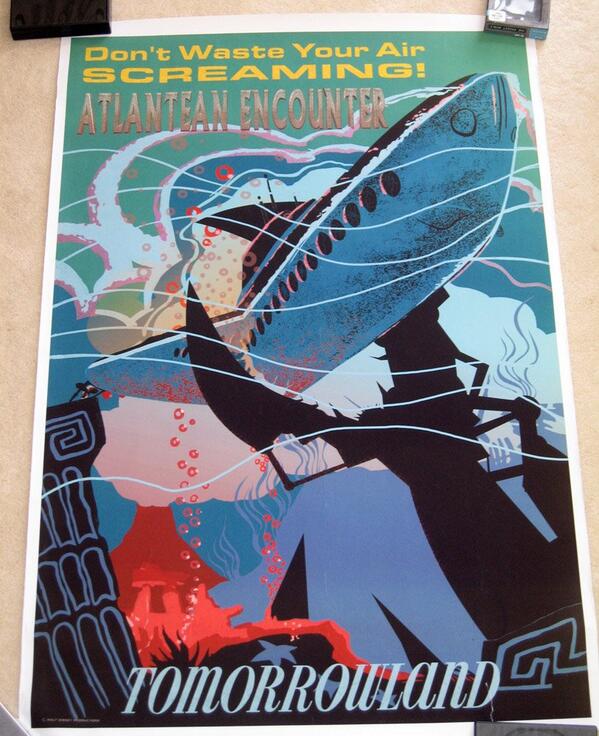
Imagineering artist Jason Shipley actually commissioned an attraction poster
for the supposed Atlantis attraction. Copies of the poster were actually
featured on the construction walls surrounding the lagoon:
The original Atlantis poster was given to Tony Baxter, who
hung it outside his office until his retirement from WDI. Presumably, as a
token of victory against the (now) departed enemy. Or so I’d like to think.
Where Did New Tomorrowland Go?
After the subs were given their final farewell in September,
work began with park management and WDI to decide what to do with the site.
Though Pressler would have liked nothing more than to just leave the lagoon
empty and save on the maintenance costs, he was now on record as saying there
would eventually be a replacement, and oh yeah Marty Sklar had practically
blackmailed him, so there had to at least be studies done to see what would be
the most appropriate replacement.
First things first, Facilities and WDI needed to know just
how much of the lagoon they could save to diminish their potential construction
costs. The week after the subs closed, the teams made the decision to drain the
lagoon as soon as possible. Facilities had to determine whether the sets and
the effects in the caverns would hold up without the water. If they held up,
then the lagoon would get refilled and testing for the expected Atlantis
replacement would begin (though the idea had not been greenlit and the concept
itself was still in flux, WDI wanted to test several proposed effects). If the
sets fall apart though, or if construction surveys prove they are unstable,
construction would be halted until after DCA opened (basically waiting until
the last possible minute to introduce the new ride). The lagoon would then sit
empty for three years to save on maintenance costs.
Luckily, the sets held up fine, and some testing began. By
most reports, the Imagineers tested at least two major effects: 1) having a
series of water cannons actually shake/batter the sub around, and 2) some
interior sub lighting effects for when the subs get attacked by the electric
Leviathan machine monster thing. In Spring 2000, WDI constructed a new pump
house for the attraction to help with the water flow.
During this time however, Pressler made it clear he was in
no hurry to finish the Atlantis concept any time soon. He wanted WDI to focus
on DCA, the resort expansion, and the Autopia and Monorail refurbishments. The
subs, though they passed their tests, would still wait on the back burner.
Throughout 2000, the lagoon received a regular clean-up
schedule to help keep it in good shape for eventual construction. The subs
themselves, unfortunately, were ordered to be put into the caverns and
maintenance bays permanently so they could be hidden from the view of Guests.
It seems that whenever the subs were being tested, or even out in the lagoon, Guest
Relations would get a series of questions and complaints from Guests as to why
the subs weren’t operating if they were so obviously able to be tested. GR, of
course, didn’t have an answer because a replacement hadn’t been officially
announced (the late 90s were a notoriously tough time for Guest Relations Cast
Members at Disneyland).
So the subs sat as Autopia and DCA construction continued,
as well as to the Monorail platform above the sub loading area. However, a
peculiar event happened in Spring 2000 that raised alarms with fans. In
accordance with ADA regulations, Disneyland built a new elevator to the
Monorail station, which took a good chunk of space from the old Monorail queue.
In response, Disneyland made the old subs queue into the Monorail queue. The
internet went ballistic again (as it does), since this move implied that
Disneyland had no immediate plans for the subs. Disneyland, of course, kept
toeing the party line and insisted something was in the works.
In Summer 2000, those plans were immediately accelerated.
What happened? Well, it seems the Negative Nancies at WDI and on the internet
were absolutely right when it came to the new Tomorrowland: you can’t build
something for half price and expect it to work.
Two years into its existence, new Tomorrowland was just now
being recognized as a flop by park management. Though it was very popular
during its first year, once the new car smell wore off the visitor numbers at
two of the major new attractions, Innoventions and Honey, I Shrunk the
Audience, were beginning to drop off significantly (by over 20% lower than the
original attendance predictions).
Even worse was the theme park Hindenburg known as the Rocket
Rods (to be detailed in a later article, stay tuned!). Long story short, the Rocket
Rods were meant to be the signature E-Ticket of the new Tomorrowland, the main
attraction that would bring Guests into the new area and increase the per-caps
for the smaller attractions, as well as the food and merchandise stands. Though
E-Tickets at the time were costing upwards of $100 million, remember park
management wanted the new Tomorrowland to be built at half-price, so a budget
of $50 million was given to Rocket Rods, half of it to be paid by a General
Motors sponsorship. Unfortunately, when GM backed out of the sponsorship, park
management refused to make up the cost difference. So, a $50 million attraction
was built with $25 million, with exactly the result you would expect. Because
money was not spent on a quality upgrade, RR began to tear apart its
infrastructure. Add to that the fact that its paltry capacity (each vehicle
carried only 5 passengers) led to giant lines (over 2 hours most days!) and
countless numbers of unhappy Guests, and Disneyland had a real mess on its
hands. Even worse for penny-pinching Pressler, Rocket Rods had a gigantic
maintenance budget due to all the mechanical and structural problems it was
causing. After all the fuss that was made about saving money by closing the
subs, he park was thrown a mother-load of maintenance headaches with its
half-assed new E-Ticket. Common sense usually wins, people. Rocket Rods sure
made the subs look like an absolute bargain real quick.
Disneyland was dealing with this headache in Summer 2000,
and decreed that the subs should return as soon as humanly possible as a safety
net for the new Tomorrowland. WDI offered to use this opportunity to push for a
minor renovation for the subs, since they were going back into full-time usage.
WDI asked park management to re-fit the subs similar to the 20K Nautilus subs
from WDW, and/or to update some of the effects and the cavern scenes. These
would have been small and simple changes, but at least they would have been
something. Evidence suggests that TDA was at least contemplating the
possibility, as reports suggest there were several massive trucks pulled up to
the load area during this time. The question most likely was how quick they
wanted to get the subs back into service.
The funny part about all this to WDI was how TDA marketed
Tomorrowland as being so “new” to get people to visit and spend money, yet by
2001 it looked like the Top 4 most popular attractions in “New” Tomorrowland
would be Space Mountain, Star Tours, Autopia, and the subs. It looks like
visitors aren’t so stupid after all, and can actually tell when something was
done on the cheap. Imagine that, Paul.
However, these plans remained in limbo until Winter 2000.
The culprit was a new development that Pressler had hoped would be a convenient
trap door for him to scurry out of once the good guys had turned the tables and
forced him to reveal his evil plans (my, that was elaborate): the wild card
that was Fastpass.
Fastpass was created in 1999 by industrial engineers and
parks ops executives, and I’m sure by now everyone reading this knows exactly
how it works. Pressler saw it as a saving grace. Instead of having to spend
tens of millions of dollars for each new ride to increase park capacity and
decrease the lines for the popular attractions (as did happen with Indy’s
opening in 1995), Fastpass would allow Guests to bypass the lines for the
current popular rides. Pressler’s team could then sell Fastpass as a new
benefit and would immediately see an increase in Guest satisfaction. An added
bonus was the fact that all the Guests carrying Fastpasses had to go somewhere
else as they waited for their return window, which meant they would have a lot
more idle time to do some eating and shopping, further increasing revenues.
Testing of Fastpass in 1999 was a success, so throughout the
year 2000 resort Executive Vice President Cynthia Harriss and Attractions
Director Paul Yeargin couldn’t stop tripping over each other to approve more
and more Fastpass attractions for Disneyland. By the end of 2000 there was a
ridiculous number of Fastpass attractions at Disneyland (even Pirates, Mansion,
and Autopia had Fastpass). Pressler felt Fastpass might be a saving grace and
increase Guest satisfaction numbers even without having to replace Rocket Rods.
Unfortunately for Paul, there was another side effect with
Fastpass. As it turns out, people
weren’t going to eat if they weren’t hungry, and they weren’t going to shop
just because. If their Fastpass window was coming up soon, they would visit
nearby smaller attractions. For example, those with an Indy FP would visit the
Tiki Room and the Jungle Cruise. Those whose windows were not for several hours
would just continue on to the next attraction on their to-do list. And, because
of this phenomenon and because there were now so many Fastpass attractions in
the park, not only were the walkways in the park becoming very congested, but
the lines for the major non-FP attractions like Jungle Cruise, Small World,
Matterhorn, and the Fantasyland dark rides, were beginning to skyrocket causing
a major drop in Ride-per-Cap numbers and Guest satisfaction, even with Fastpass
operating (IT’S THE RIDES STUPID).
And so, it was back to Plan A. However, by now the closure
of Rocket Rods was now several months gone and there was an increasing amount
of Guest complaints. At this time, WDI made a serious push for park management
to re-open all of the attractions it had closed in the 1990s that still had
their infrastructure intact (Aaaarrrrr! The pirates prepare to board the enemy
ship! Judson Green’s mandates be damned!). These included the Keelboats, the
Motorboat Cruise (whose track was still there, and was always popular with the
under-7 crowd and their parents), the re-installation of CircleVision to
replace Rocket Rods, and of course, the Submarine Voyage. WDI argued this would
be a very simple and cost-effective way to absorb the crowds and add some
much-needed ride capacity.
Pressler said he would have the rides open for the following
summer, in 2001. In the meantime, he expected the opening of DCA to take some
heat off of Disneyland (remember, this was the time that TDA still thought DCA
had a chance to be successful in any way, shape, or form). Once things really
started to get rolling for the summer season, he would pull the trigger and
have the new rides open by Memorial Day weekend.
What he did not expect was for DCA to be an enormous flop,
and be an enormous leach to Disneyland’s profits for a decade. So, all
available funds were pressed into DCA to recover its pitiful attendance, as I
detailed in my
Superstar
Limo article.
However, by Spring 2001, something had to be done. DCA
crashed and burned out of the gate, and because of the Rocket Rods closure
Disneyland was down one E-Ticket. Guests were complaining they felt more had
been taken away in the last five years than what had been added. Tomorrowland
was a case in point, as all the new offerings fell quite flat. The skyrocketing
Guest satisfaction scores from Fastpass never materialized. And the only thing
Disneyland had on the books until the 50th Anniversary was a
watered-down Winnie the Pooh dark ride to replace the Country Bears. So, WDI
made its final push for a new Submarine E-Ticket experience, planning to open
in 2002 or 2003.

You’ve got to remember, back in the day, that Disney was obsessed with turning its “event” family
pictures, animated or otherwise, into theme park attractions. And if they
couldn’t be attractions, then there at least needed to be shows or parades.
There was Voyage of the Little Mermaid, the Beauty and the Beast stage shows at
Disneyland and MGM Studios, the Aladdin and Lion King parades, Legend of the
Lion King at MK and Festival of the Lion King at DAK, the Pocahontas and
Hunchback shows at Disneyland and MGM Studios, the Hercules and Mulan parades,
and Tarzan’s Treehouse. We also almost got a George of the Jungle Cruise and a
Journey Into Imagination replacement based on Flubber. Eisner literally could
not help himself when it came to synergy between Disney Animation and the theme
parks. So, it was natural for WDI to have this concept for Atlantis already
rarin’ to go.
A quick digression here about Atlantis. While it has never been one of the more successful
animated movies in the Disney canon, it has always been recognized as one of
the most underrated. The concept for the movie has also been kept in high
esteem because we have rarely seen an animated movie so ambitious as Atlantis. Like Snow White, Pinocchio, Fantasia, Bambi, Sleeping Beauty, Toy Story, and
Wall-E, Atlantis was meant to be more than just another notch on Disney’s
belt. After finishing Hunchback of Notre
Dame, directors Kirk Wise and Gary Trousdale and producer Don Hahn decided
they wanted to do Disney animation’s first big action/adventure yarn (Rescuers Down Under never happened. Shut
up.) This wouldn’t be just a normal action movie though, they were going Jules
Verne/Steven Spielberg huge with the movie. And, since Disney was still in the
mindset that any animated movie could be a smash hit if given the right
concept, approved a $100 million budget for the big action flick. Whoa.
What really sunk Atlantis
(hyuck hyuck) though was the fact that Disney experienced an enormous talent
exodus in the late 90s. Part of the reason the early-90s Disney animated flicks
were so good was because they literally had every creatively talented person
working on each and every movie. It was like a moveable all-star team. They
produced their best work in movie after movie, with bigger and bigger budgets.
However, this talent would become diluted in the late-90s because 1) Disney
decided to ramp up production and start producing at least one animated film a
year, thus spreading out their most creative people, and 2) The competition
finally saw that animated movies could make oodles and oodles of money after Lion King and started offering Disney
animators a ludicrous amount of money to jump ship. Many of the talented Disney
animators after Lion King would end
up working for Pixar, or for DreamWorks on Prince
of Egypt, or for Fox on Anastasia and
Iron Giant. So unfortunately, Kirk
and Gary had only a fraction of their Beauty
and the Beast team at their disposal.
But hot damn, did they try to really blow the doors off the
place with Atlantis. The movie is
truly an action-adventure extravaganza, with an entire army of memorable
characters. They hired comic book artists such as Hellboy’s Mike Mignola and art directors from live action movies
such as Jurassic Park and Men In Black to design the look of the
film. There are many scenes and set-pieces that are quite mind-blowing. Alas,
executive meddling caused some problems with the script and the plot, and the
movie did not resonate with audiences.
But, Disney had planned for the movie’s eventual success, and
readied quite a bit of follow-up material: a direct-to-video sequel (Milo’s Return), several video games, and
a TV series, Team Atlantis, which
would have hearkened back to the animated adventure shows of the early-90s like
Batman and Gargoyles, as Milo and his team travel the globe to hunt for
treasures and find a way back to Atlantis. And, of course, theme park
attractions.
The Imagineers came up with quite a few concepts for the
Atlantis Expedition concept. Originally, it was to have been a solid re-imagining
of the Submarine Voyage, with new in-sub lighting and sound effects, as well as
mechanical effects in the lagoon like the Leviathan figure. There was also talk
of an interactive element.
However, once the concept got revved up to E-Ticket status
to replace the hole left by Rocket Rods, it was Blue Sky time. As you saw in
the poster earlier in the article, an idea was hit upon by the Imagineers to
bring Alien Encounter to Anaheim. Pressler had originally rejected Alien
Encounter for the new Tomorrowland at Disneyland as being 1) too scary and 2)
too expensive (not necessarily in that order). But many people forget now that
Alien Encounter was seen at the time to be one of the flagship E-Tickets of the
new technological age of Imagineering in the 1990s. Among Imagineers and fans,
AE was mentioned alongside Indy, Tower of Terror, and DLP’s Space Mountain as
the best cutting-edge attractions in the world at the time. So it was
disappointing from everyone’s perspective that AE did not make it to the West
Coast. Indeed, it was one of the favorites of the Imagineers. So, they decided
to bring it to Disneyland in a new way.
The Atlantis Expedition was renamed the “Atlantean
Encounter.” No, really. The tagline was going to be “don’t waste your breath
screaming.” Or, alternatively, “don’t waste your air screaming.” The Imagineers
felt, with the constricting submarine environment and the presence of the
movie’s Leviathan as the suitable King Kong-esque monster attack, an Alien
Encounter-type experience would be most appropriate, and certainly bring some
thrills to Disneyland. I told you, the late-90s are a REALLY FREAKING
INTERESTING time for WDI.
Since the concept had been bumped up to E-Ticket status, the
Imagineers pulled out all the stops to deliver a one-of-a-kind experience,
pulling from many of the new technologies developed in the mid-to-late 90s.
What follows is a cliff notes version of what was planned for the attraction:
Guests would be taken through a new queue area very similar
to Tokyo DisneySea’s Journey to the Center of the Earth attraction (though very
truncated), designed as a Jules Verne-esque lab for the eccentric millionaire
Preston Whitmore. For whatever reason, Guests would be taken via submarine to
go on a treasure-hunting or fact-finding or rescuing or touristy journey to
Atlantis. The subs themselves most likely would have looked like the old
WWI-era subs found in the movie, though still similar to the old models.
In the lagoon portion of the attraction, Guests would be
taken through the Graveyard of Lost Ships as depicted in the movie, which
features sunken ships from every conceivable era of human history. This would
have been the interactive element. In this section of the attraction, each
Guest was to have a controllable claw arm that would be used to grab items from
the bottom of the lagoon. Think of like a retractable mechanical gizmo like the
arcade-style “claw” game. Disney would have filled the bottom of the lagoon
with cheap trinkets that look like treasure and jewels, that Guests could pick
up and put in a basket attached to the sub.
Eventually, the lagoon would become increasingly darker.
Guests would see movement on the bottom of the lagoon…something BIG. And
finally, gigantic red eyes peering out from a distance. The floor of the lagoon
would appear to move. Water cannons would buffer and shake the sub around,
Catastrophe Canyon-style. A giant animatronic head of the Leviathan would rear
up from the dark. And then the chase would begin.
This would also begin the Alien Encounter-style portion of
the ride. Sort of a cross between AE, Kongfrontation, Catastrophe Canyon, and
many of the other Universal-inspired “disaster” rides. The lighting in the sub
and out in the water would go pitch dark. The Leviathan would grab the sub, and
as he did the interior of the sub would start to crush itself in, Toontown
Trolley-style. Electrical effects would spark. Water would start to spray and
leak onto the floor.
The sub would eventually get free and escape into a deep
tunnel (the caverns sequence). Guests would hear the Leviathan chase the sub.
Once the subs reached a certain point, the windows of the sub would actually
transition into simulator screens. Guests would no longer be looking out onto
real-life sets, but onto images projected on the portholes. The sub would make
it to Atlantis, with the Leviathan chasing behind. The Leviathan would give the
sub one final blast of electricity (igniting an impressive light show inside
the sub). Like in the climax of the film, there would be a huge volcanic
explosion (another reason to shake the sub) and the sub would escape back to
the surface.
Stories differ as to what exactly happened to the treasure
Guests collected during the lagoon sequence. Some stories claim Guests would
have been able to keep the trinkets they were able to put in their basket.
Others say that the sub’s captain would have lamented that the Leviathan battle
caused the sub’s baskets to lose the treasure, but as consolation all Guests
would have received a commemorative Atlantis coin upon departure.
Anyway, that would have been quite an E-Ticket experience!
As you can guess, there were several factors as to why the attraction was not
green-lit. First, of course, was the DCA catastrophe. Pressler’s attraction
budgets were meager to begin with, and once DCA started to hemorrhage money all
the money for any new Disneyland attractions (save Winnie the Pooh and the
Merchandise Tree) had to be folded into getting DCA back on its feet (Tower of
Terror, Luminaria, Aladdin, etc.)
The second reason was because of the movie’s lackluster
results. Atlantis only grabbed $84
million domestically, which was lower than what Disney animated movies were
used to (even the Pocahontas/Hunchback/Hercules/Mulan
lineup made $100-150 million apiece). Though, it should be noted, it was still
one of the Top 30 grossing movies of 2001, and still did better (inflation
adjusted) than some of Disney latest efforts, like Through the Looking Glass and Pete’s
Dragon. Now, it was successful enough for the Milo’s Return sequel to be made, but alas, it was not successful
enough to spawn a new Disneyland E-Ticket, nor the exciting Team Atlantis TV show. Which is a huge
loss to us comics/adventure lovers.
Of course, Disney at the time was still obsessed with (and responsible
about) synergy, so Atlantis did end
up making its way into the parks. Remember, at this time Disney still
maintained that every single animated release get its own Emporium window
display:
And every animated release get its own walk-around characters:
Did they get invited back for Long Lost Friends? Was there a Casting Call for Milo?
Though, depressingly, some PR or ops flack had a brainfart
and positioned the Atlantis characters right in front of the empty sub lagoon.
So much for Guests not asking questions! Someone fell asleep at the switch
there.
The Infamous January 2nd Bob Iger Disneyland Tour
The saga of the subs, as we all know, has a mostly happy
ending. Though we did not get the uber-Atlantis E-Ticket, we did receive the
solid Finding Nemo replacement. But
this still was not without its conceptual and construction headaches. After
all, Eisner was still in charge.
Paul Pressler left the company in 2002 to fall into the Gap,
and with him came and went his promise that the subs would be back within 5
years. Pressler was replaced as the Disneyland President by Cynthia Harriss in
1999 and as the Chairman of Parks and Resorts by Jay Rasulo in 2002, who had
their own operational concerns to deal with at Disneyland.
Now that Pressler was gone, the head honchos who ran Ops at
the parks pleaded with Jay about the Ride Per Cap crisis. For those of you who
don’t speak theme park Ride Per Cap is the simple act of dividing the total
number of turnstile clicks of every attraction in the park by the total
attendance for the day. This tells Disney the average of how many attractions
each patron visits per day. What’s cool about this number is it can be a good
predictor of overall Guest Satisfaction. See, when RPC dips under 9, complaints
begin to rise quickly at GR and Guest Satisfaction begins to go down. Disney’s
bottom level of acceptability is 8.5. Once the park gets busy, the lines get
longer, and people are waiting in line instead of buying food and merchandise.
Also, they’re more likely to leave earlier without buying anything. Not good.
However, as of 2003 the Ops managers had some alarming news
for Jay. Since so many attractions had closed without replacement (not to
mention restaurants like Plaza Pavilion, Tahitian Terrace, and Brer Bar),
comparing the capacity and Ride Per Cap numbers, the Ops team concluded that to
keep Disneyland’s lowest level of acceptability (8.5 attractions per cap),
Disneyland could only accommodate a yearly attendance of 11.5 million visitors
per year. As it happens,
Disneyland hosted 12.7 million visitors in 2002 during a recession year. Oh
dear.
By any stretch of the imagination, DL had to provide
attraction accommodations for at least a few thousand more Guests per hour to
get those numbers back up. Winnie the Pooh was set to open in 2003, but with
Disneyland used to 14-15 million visitors per year in the booming 1990s, they
would need much more help (they REALLY missed the PeopleMover at this point…and
still do). Problem is of course, Eisner was still in charge and didn’t like
seeing too much money being spent on attractions that couldn’t sell tons of
merchandise or at least be featured on a billboard.
To add insult to injury, Space Mountain was due to go down
at the end of 2003 for an 18-month refurb leading up to the 50th. Space
has a capacity in the neighborhood of 1,800 per hour, and Winnie the Pooh can’t
cycle nearly that much, so DL was going to be even worse off at the end of
2003. So, to add more capacity without spending too much money, the old
Disneyland Plan A was again re-visited. The subs were a major target because
when Space would go down (and the lackluster performance of Tomorrowland ’98),
there would be crickets chirping in Tomorrowland. Cynthia asked for a quick
cost analysis to see how much it would cost for the subs to go back into
service by Thanksgiving 2003. Unfortunately, the price tag was above the
expected $10 million due to some sink hole and leak problems, so Cynthia
decreed that DL would just have to deal with unhappy Guests in 2003.
Meh, we'll read this later
The subs were never out of mind, however. At the infamous
Cast Blast event of 2003, Cynthia, Jay, and Marty Sklar were scheduled to unveil
the plans for Disneyland’s 50th Anniversary to the congregated Cast
Members. However, famously, Jay completely stiffed his team and failed to show
up. This led to Cynthia’s immortal time-wasting exercise of showing the Cast of
Disneyland her sofa paintings of the Laguna cliffs and sharing with all in
attendance her stories of meeting friends at trendy Laguna restaurants. Marty
didn’t fare much better, since they didn’t have much to show for the 50th
he ended up filling most of his time with a slideshow depicting the plans for
Hong Kong Disneyland.
AHAHAHAHAHA you're terrible Cynthia
At the end of the presentation, though, was a Q&A
session. Cast Members were able to ask Cynthia and Marty anything they wanted.
Near the end of the Q&A, an intrepid DCA ride operator asked Marty, “I
heard rumors the Submarine Voyage will be coming back. Any truth to that
Marty?” Cynthia shifted uncomfortably in her seat, but Marty produced a wide
smile. “I can neither confirm nor deny those rumors,” he said with a chuckle,
“we are looking at several things for Disneyland, and that may be one of them.”
This gave the clear indication that the subs were on everyone’s radar. But when
would they be able to pull the trigger?
Indeed, not long after the Cast Blast, Cynthia’s crew
decided that DL would be best served by replacing the old CircleVision area
with the new Buzz Lightyear’s Astro-Blasters attraction, due to its much more
obvious marketing and merchandise potential. Alas, the subs would be put on
hiatus a little while longer.
What made matters even worse was the fact that, just the
year before, head of Facilities T. Irby had gone on a “clean out all the
warehouses” rampage and literally thrown out practically everything held in a
Facilities or Engineering warehouse that was not needed within three months.
These warehouses held the molds of the figures and props found in the
attraction (fish, rocks, lobsters, etc.), which were necessary to re-build the
props and figures in the attraction. This action would have added millions of
dollars to the eventual renovation. It’s not even a cliché anymore when we
remind you that Pressler’s team was penny-wise, pound-foolish. These sorts of
actions were exemplary of his dark reign.
Pressler posing in front of Cosmic Waves, 1999
Fortunately, hope for the resort would not be long delayed.
One of the unbeknownst most important days in Disneyland’s history was January
2nd, 2004. After new Disneyland President Matt Ouimet and his new
Executive VP of Ops Greg Emmer became the new head honchos at the resort in
October 2003 (Cynthia retired to “spend some time with her family” for all of
two weeks before following Pressler to The Gap), they immediately set their
sights on tackling DL’s severe capacity issues. Yet, they were concerned that
upper management would not give them the budget they needed to make the
necessary changes.
Hence, on a very rainy January 2nd, Matt and Greg
hosted a full walking tour of the Disneyland Resort with Bob Iger and Jay
Rasulo. At the time, barely any funds were scheduled for Disneyland’s TLC
leading up to the 50th. Matt and Greg were beyond determined to
change all that. They showed Bob and Jay all the peeling paint, all the crowd
flow bottlenecks, all the tiny wheelchair entrances (at Mr. Toad and Peter Pan,
as an example of the park’s aging infrastructure), all the malfunctioning
figures in the Tiki Room, the empty Festival Arena, everything. They finally
visited Tomorrowland, which was all but dead without a working Space Mountain.
Matt and Greg communicated to Bob that this sort of presentation would not look
good when the Good Morning America
cameras started rolling during the 50th. Bob Iger readily agreed.
And so was the unofficial beginning of the Project Sparkle and Placemaking era
of Disneyland.
Add some fuel to the fire in the form of Roy Disney and
Stanley Gold beating the hell out of Eisner for his stingy penny-pinching in
the parks during the very public Save Disney campaign, and you have a recipe
for a brand new Submarine Voyage. By the summer of 2004, Tony Baxter had
started to lead the charge to get the subs back into operation. The concept
would very obviously be attached to Pixar’s new underwater mega-hit Finding Nemo, which took in $625 million
at the worldwide box office in 2003. After more than a year of planning, it was
announced in 2005 that the subs would return in Spring 2007, fresher and better
than ever before. And they lived happily ever after. Except for the constant
rumors that they would be replaced again. But, for now, they’re happy.
And so ends one of the strangest stories of on-and-off
neglect for a major theme park attraction. The subs are pretty much a unicorn
attraction, even today executives simply don’t know whether the current
incarnation is helping or hurting the bottom line. But because it is such a
unique attraction, it is so memorable for us. And regardless of the Ride Per
Cap or capacity stats, its demonstrated continued popularity has proven that it
is memorable for many Disneyland visitors as well. It doesn’t make sense to a
lot of people why fans get so emotional about the subs, or Toad, or the PeopleMover,
or the Monorail. From a wide-angle view, these attractions may not seem that
special. But they’re special to us precisely because they’re so unique, and
continue to be. Anyway, it’s special enough to cause WDI to do all but sack the
dock and invade the caverns on the infamous Flag Incident of May 15th,
1998, one of the greatest unknown moments in Disneyland’s history. But keep a
weather eye open mates, thar be sofa paintings!
**Send Jeff a line at HamGamgee@gmail.com, or follow him on Twitter @Parkscopejeff.
Other "Wish Upon a
Blue Sky" Articles
#24:
Museum of the Weird and The Rogues Gallery
#25: The Asian Safari and the Animal Kingdom Dilemma
#26: The Incredibles
#27: Enchanted Snow Palace
#28: Fantasyland Trio 2.0
#29: Discovery River
#30: The Original Superstar Limo
Introduction